Showing posts with label People. Show all posts

Sunday, September 18, 2016

Full Circle: Tallmadge's Namesake Leads the Way in AMC's TURN: Washington's Spies


It’s not every day you hear a familiar name on TV, but if you’ve ever watched AMC’s TURN:Washington’s Spies then you’ve certainly come across one of the show’s main characters, the dashing Colonel Benjamin Tallmadge, who helps maintain George Washington’s military intelligence operation during the Revolution.

If you’ve ever wondered whether there was a connection between this character and Akron’s neighbor to the northeast, the answer is absolutely YES.  Tallmadge (played on the show by actor Seth Numrich) was founded in 1806 by Rev. Davis Bacon, and Colonel Tallmadge was one of the first property owners. Bacon named the township after Tallmadge precisely because of his well-known, highly-respected name, which was known throughout New England.

While a major landowner and investor, Tallmadge was never a local resident. He maintained his home in Litchfield, Conn. and was happy to support Bacon, a missionary whose religious views he fully shared. Eventually, Bacon obtained a contract of purchase with Tallmadge and the other dozen or so investors in the settlement, which stipulated that whenever payment of any part was secured, a deed would be delivered for that part.

Tallmadge was leader of  the Second Regiment of Continental Light Dragoons, also
known as Tallmadge's Dragoons.

While much of Colonel Tallmadge’s notoriety comes from his espionage activities, he had an equally distinguished service in more conventional military activities, participating and leading forces in several important military actions against the British and their Tory sympathizers. After the war, Tallmadge flourished as a successful businessman, land speculator, and served several terms as a Federalist Congressman. He died in 1835.

It’s important to remember that years ago, a large section of east Akron was actually part of Tallmadge, which extended down across Chapel Hill and down through Goodyear Heights towards Middlebury, until it was eventually annexed by the city. Even today, if you look at a map of Akron, you can see that for the most part, there really is no “northeast Akron”—what would be is mostly Tallmadge, and Cuyahoga Falls.

As for Bacon, his plans for settlement did not offer much personal success; there was little hard cash available for new residents to buy land, and he was forced to return to New England after 1811. Bacon's idea was a good one, it just took longer to develop than he expected. Those who did stay here held on long enough to see the settlement prosper and grow into a successful town and today, their descendants can claim a prosperous city.
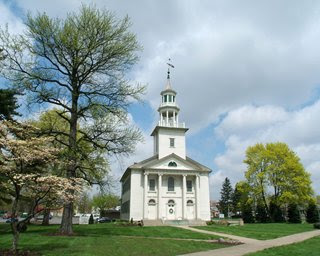


With that in mind, it seems appropriate that we take a moment to enjoy Colonel Tallmadge’s newfound posthumous fame. It makes the TV show that much more fun to watch.


Thursday, September 08, 2016

Akron's "Other" Brewer: The George Renner Brewing Company

Everyone in Akron has heard of Burkhardt’s Brewery; located on Grant Street in Wolf Ledges, it is currently home to two current Akron breweries, Thirsty Dog and Aqueduct, who share space at the cavernous old brick building.

Up until recently, the former Akron Brewing Company, too, was highly visible—its large brick edifice overlooking the westbound lanes of I-77 where it crossed Broadway. Sadly, the building has recently been demolished due to reconstruction of the exit ramps there, near South Main St.

For the most part, only area brewers, long-time residents and brewerania collectors are familiar with Akron’s other major brewer, the George Renner Brewing Company, whose plant and ice house was located on North Forge St., just west of North Arlington, near Adams St. The facility is still there, spanning both sides of North Forge; most impressive is the ornate brick 1880’s-era boiler and bottling house on the north side of the street.

Renner's old brewery buildings still stand on North Forge St.
Born in Germany in 1835, George Renner was among a number of German immigrants who settled in the area during the 1800’s. He came with his parents to Cincinnati in 1849, where he learned the brewing business, then moved to Wooster in 1882, where he opened his first brewery. He stayed there for about four years, opened a brewery in Mansfield in 1886, and finally settled in Akron in 1888.

Old Cockney Ale. Seems highly sessionable, with only 3.2% " ABV. You can drink a LOT.
In Akron, he purchased an old brewery on N. Forge and began making substantial improvements and continued to enlarge the facilities. Soon, Renner’s operation became one of the largest breweries in Ohio, selling over 30,000 barrels annually with a capacity of over 50,000 by 1910.

Through the late 19th and early 20th centuries, Renner produced a wide range of popular beers, like the popular Grossvater (Grandfather), Old German, Lucky Shoe, Old Cockney Ale, Half and Half and Souvenir Bock. The Prohibition era was a tough time for all of Akron’s breweries. When it finally ended at 12:01 A.M., on April 7, 1933, a crowd of 2,000 people waited in line outside Renner's brewery in a cold rain to purchase some of the 5,000 cases of their Grossvater  brand beer that were available at $3.25 per case. By noon the next  day, 10,000 cases had been sold at the brewery and through  shipments all over northeast Ohio and western Pennsylvania.

Today, Brewerania collectors seek out old bottles, cans, labels and crates featuring this venerable old brewery’s name and products. Renner’s son, George Jr. was a successful brewer in his own right, moving to Youngstown and opening a very successful brewery there, marketing many of the same brands as the Akron plant.


Sunday, August 21, 2016

Akron Street Names: Melvin Vaniman and His Pal, Kiddo.

Melvin Vaniman and his adventurous pal, Kiddo.
Truth be told, Melvin Vaniman wasn’t even from Akron, though he has a street named after him in Goodyear Heights. Born in Virden, Illinois in 1866, he started out as a photographer — but wedding portraits were simply not his thing.

No, Melvin gained a worldwide reputation as an innovative panoramic photographer, creating promotional images in far off places like Hawaii, New Zealand and Australia. Many of his beautiful images were shot from hot air balloons, using his own “swing-lens” camera design to capture full 360×180 degree panoramic images.

This is the type of panoramic photography Vaniman became noted for - taken from a balloon.
Around 1904, Melvin grew bored with photography and took up exploration, including two attempts at crossing the North Pole, the first in an airship named America. In 1910, his first trip across the Atlantic in the same airship was unsuccessful when the engines failed and his crew had to be rescued by a Royal Mail steamship. 

Through almost all of his adventures, Vaniman was accompanied by a faithful friend and traveling mascot, Kiddo — a tabby that came to be well-known as “The Airship Cat.” During his initial attempt to cross the ocean, Kiddo (who had been a stowaway in the airship's lifeboat) ecame quite disruptive inside the airship’s gondola, causing Vaniman to radio his launch boat to “come and get this goddam cat!” Fortunately, the tabby was among the crew later rescued.

Melvin Vaniman named his second airship Akron at the request of Frank Seiberling, who agreed to have Goodyear manufacture the craft's giant gas bag. Airship development was still in its infancy; Goodyear was just getting started in its lighter-than-air efforts, and it would be a few years before Goodyear’s airships and zeppelins became well known around the world.

A promotional post card for Vanima's Trans-Atlantic expedition.
Melvin made his second bold attempt at an Atlantic crossing in 1912. Just off the Jersey shore near Atlantic City, the Akron, which was of advanced design and filled with over 11,000 cubic meters of hydrogen, burst into flames and exploded — plunging the ship’s gondola over 750 meters to an inlet. Neither Vaniman nor his four crewmen survived.

Vaniman's airship "Akron" - a photo taken as it left on its final journey.
Two years later, when Goodyear Heights was laid out, Vaniman’s brave effort would be forever memorialized by one of the neighborhood’s streets. Thankfully, no street would be named to memorialize Kiddo; Melvin’s feline friend retired from flying for good after the 1910 trip.


Friday, August 19, 2016

Built for Speed: The Arfons Brothers


Walt (left) and Art (right) Arfons.
It figures. Only a guy from Akron would have the ‘nads to strap a jet engine onto four wheels and go racing. But in this case, there were two guys, Art Arfons and his half-brother, Walt.

Their father, a Greek immigrant, came to America at the age of 14 and settled in Akron, where he operated a feed mill. The brothers’ natural ingenuity and mechanical skills found an outlet in working on cars, and though Walt was ten years older than Art, they forged a common bond in their desire to go fast.

One of the Arfons Brothers' first Green Monster Drag Racers
In 1952, they built their first dragster, a three-wheeler with an Olds 6-cylinder engine, pained a hideous green shade that matched their old Oliver farm tractor. Dubbed “The Green Monster” by the track PA announcer, the name stuck for all of the brothers’ joint projects.

Using surplus aircraft piston engines at first, the brothers raced throughout the 1950’s. They were the first drag racers to hit 150 mph in a quarter mile, and continued to do so using subsequent versions of The Green Monster.

Around 1960, the brothers parted amicably and followed their separate paths, although they continued to compete with each other on a friendly basis. Art headed to Bonneville with an Allison aircraft engine powered car that hit over 313 mph in 1961.

Being no slouch, brother Walt became the first to introduce a jet-engine dragster in 1960, utilizing a parachute to slow the car down at the end of the run. In 1967, Chrysler Corporation gave Walt a Dodge Dart, Plymouth Barracuda and Dodge Charger to convert into dragsters. Walt simply strapped jet engines onto all three stock cars and went racing.

Need more speed? Just find a jet engine and strap it to the back of the family car.
During the 1960’s, both brothers returned to the Bonneville salt flats many times with new and innovative jet-powered cars they designed. During 1964 they went back-and-forth against record-holder Craig Breedlove and his Spirit of America, Art in a new Green Monster and Walt in the Wingfoot Express. Hitting record speeds of over 400mph (Walt) and 500mph (Art) the brothers battled across the salt flats with all comers for speed record supremacy.

Art Arfons with his 1966 edition of The Green Monster.
In later years, the brothers drove less and spent their time mostly designing cars, with Art enjoying great success in jet turbine powered tractor pulling competitions, and being named to the Motor Sports Hall of Fame in 1991. Art passed in 2007, and older brother Walt passed in 2013. Today, you can still see their Green Monster sign out on Pickle Road, north of Killian.

A little bit crazy? Maybe. What we can say for sure is that when it comes to “life in the fast lane” — no one showed the way better than the two brothers from Akron.

Saturday, August 13, 2016

The Story Behind This Web Site...


Little Big Town originated with a 2015 Medium post I wrote that outlined how our city’s landscape had changed so much over the past 150 years, and how the rapid expansion of the city—due to a series of “boom” periods—had caused it to be significantly transformed several times over.

The notion of Little Big Town also got its inspiration from Akron’s foremost historian, Dave Leiberth, who has referred to our city many times as “America’s Biggest Small Town” - as well as University of Akron professor George Knepper, who has often noted that “Akron has many accomplishments disproportionate to its size as a city.”

I would also be remiss if I did not give some credit to the creators of the great NYC history blog, The Bowery Boys, who have provided a lot of inspiration, if not the model, for how to produce and sustain an engaging and entertaining city history blog.

One of my favorite pastimes on Twitter has been digging up old images of Akron, posting them as a “PastBlast”—not only in an effort to inspire fond memories in older generations of Akronites—but also to inspire younger generations and make them understand that almost anything is possible here in our city. Rather than sending a message about “how great it used to be”, the goal is to show how creativity, hard work, smarts, and that peculiar Akron World View made our city such a special place. Today, I see many of the same skills are being put to work by a younger generation right now to shape Akron for an exciting and unpredictable future.

So many of the young people I come across see these historic images and hear these Akron stories, and the reaction is typically something along the lines of:

“What a great idea that was. Let’s do it again—but better.”

“Those people were a little bit crazy. Just like us.”

“Who would have thought you could do that here? But they did. So can we.”

“Some of those great ideas we hear about today? They were doing that in Akron 100 years ago.”

“They didn’t have much to start with. Neither do we. But look where they finished.”

While the city limits here may not stretch as far and wide as they do in America’s great metropolises, one thing people from Akron have proved again and again is that there is no limit to our imaginations—or our creativity. Perhaps somewhere in this collection—in this colorful Akron memory book—a new generation will find a spark of inspiration to create their own unique and remarkable history in this overgrown small town.

If you have any ideas or suggestions for stories, feel free to pass them along.